Does Artificial Intelligence drive a bulldozer through photography and other creative pursuits? It depends what you’re pursuing.
To begin, it is perhaps worth reiterating what a photograph is:
photograph
a picture made using a camera, in which an image is focused onto light-sensitive material and then made visible and permanent by chemical treatment, or stored digitally.
Alternatively, consider the etymology of the word photography and find that it means literally ‘writing with light’.
In comparison, AI-generated images are composed solely by manipulating digital data using complex algorithms running within a computer system. Digital photography also involves computerised processing, but the starting point is always light. AI-generated images may use existing photographic data as their starting point, and may have a convincing photo-like appearance, but they are not photographs because they are not made directly from light.
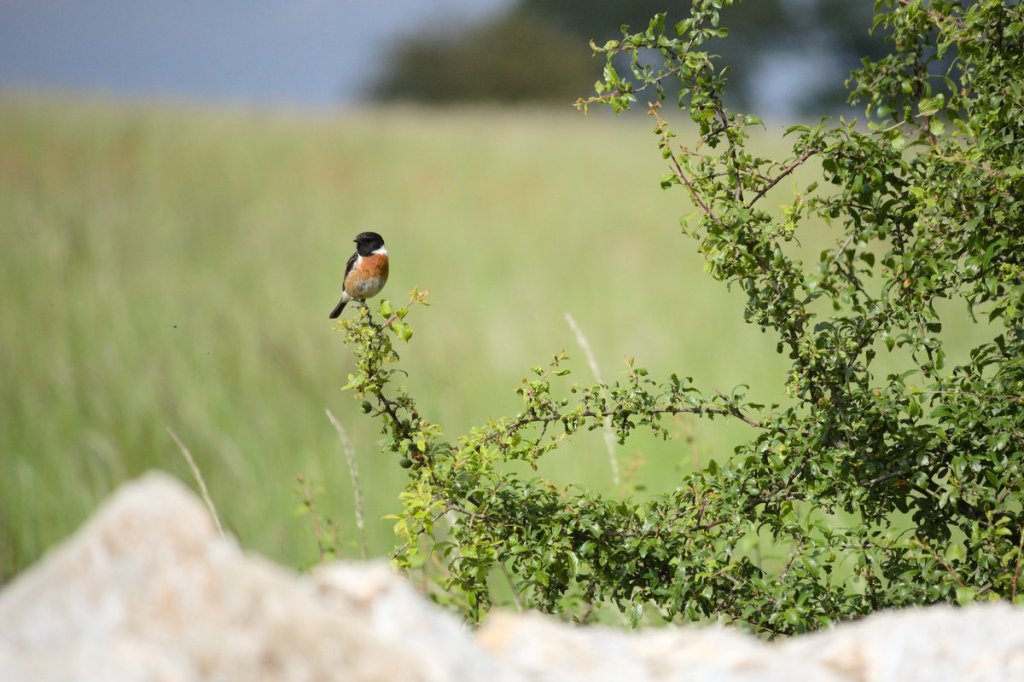
All images on this blog (with the exception of the example AI image in this post) are photographs: recordings of real moments in space and time. While I use digital cameras and editing tools, I do not use any image-generation software, including those with AI algorithms. Everything in my photos was visible through the lens when the shutter fired and everything that was visible is included, within the limits of the camera.
Photography comes down to selecting what appears within a real-world image and how these things relate to each other. Obviously the first requirement is to be physically present among, or with, your subject, followed by seeing the potential for an image and using a combination of positioning, focal length, aperture and shutter speed to portray what seems important in effective way.
The success of the resulting photo is a nebulous thing – beauty is in the eye of the beholder. No doubt, an AI tool could be used generate photo-like images that would easily prove more popular than anything I or anyone else have ever produced via a camera. Actually, that has been the case for a long time – even early editions of tools like Photoshop could be used to create all manner of images, both fantastical and realistic. The difference is that the Photoshop route required significantly more work than haphazard prompting.
But AI and other computer-generated images are fundamentally different. There is no fleeting light or stubborn shadow; no flock of birds or rocking branches in the wind; no frost, mist, rain or thunder. In fact space and time are basically absent, so while the output of either process is an arrangement of pixels, the two things are apples and oranges philosophically speaking.
This does not make one thing ‘better’ than the other, in the same way that photos are not necessarily ‘better’ than paintings or vice-versa. However, given AI’s ever-increasing ability to create persuasive images that look plausibly like photos (or paintings), it seems important to make the distinction.
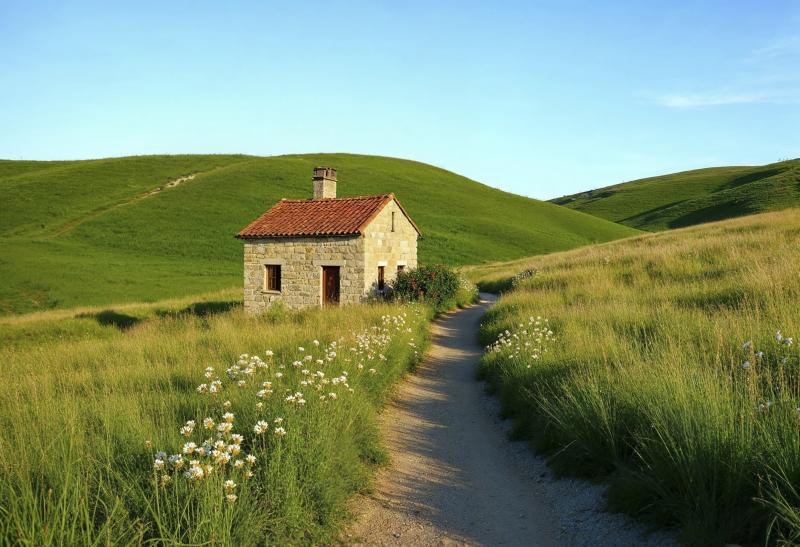
When it comes to photo-like AI generated images, what are we actually dealing with? Below is an example of an AI-generated image that I found on http://www.freepik.com. It was among the first hits resulting from a search for ‘cotswold’ and to freepik’s credit, it is very clearly identified as AI-generated.
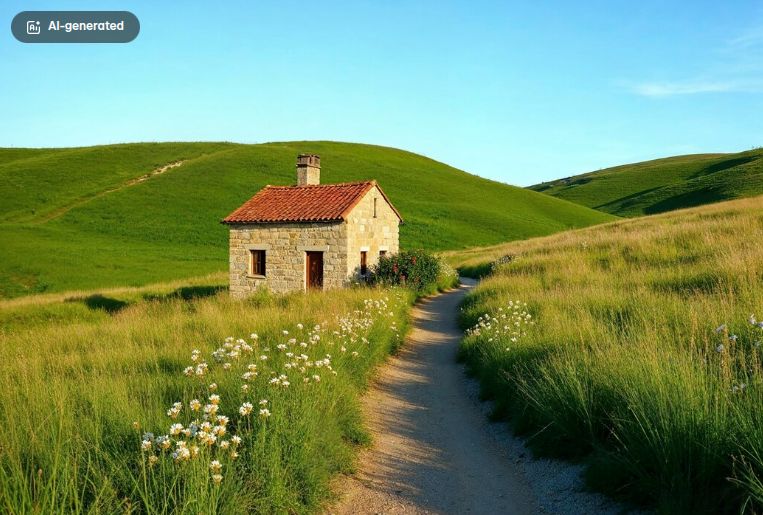
Superficially, the scene is reasonably convincing and pleasing to the eye. The lighting, long grasses and what might be oxeye daises are suggestive of a clear summer evening in June or early July. The colour of the stone is suitably Cotswold-ish as is the gentle curve of the grassy hills.
However, the more you look at what I take to be a ‘converted shepherd’s hut’, the less feasible it seems. The roof line appears to be quite high for such a building and there is an aperture in the end wall suggesting a loft space, yet the overall size does not seem to warrant a loft. If there is a loft, much of it must be taken up with the enormous chimney stack (which looks vaguely like a miniature Norman church tower) whose bulk suggests that any fire within would be overpoweringly hot. Perhaps it’s not a traditional shepherd’s hut but a shepherd’s sauna…as in, er, “red sky at night, sauna’s alight”.
Whatever it’s supposed to be, the hut-barn-sauna-cottage is some kind of dwelling, in which case it would be much more likely to have vehicle access via a rough track rather than the manicured gravel path, not to mention an SUV parked outside it and some wheelie bins dotted about. Of course this assumes that such a place would be granted planning permission, which it probably wouldn’t…
Does any of this matter? Maybe not. If the purpose of that image is to attract people to the Cotswolds or anywhere else with green hills and pleasant airs, it may well succeed (even if the ‘traditional shepherd’s sauna’ turns out to be an industrial unit just off junction 12 of the M5). In the context of a tourist brochure or web site, a superficial glance is perhaps all such an image would ever get and the fact that the place does not exist becomes immaterial.
That may be depressingly reflective of the limited attention span photos generally receive and also indicative of a certain kind of surface level ‘insta-tourism’, but these are societal trends that existed well before AI became mainstream.
From my perspective, the success of otherwise of AI-generated images like these is interesting, but more or less irrelevant. I don’t aim for or expect any financial or other material gain from photography, I do it because I enjoy it. Whether it’s a vintage edition of Photoshop or the latest AI image manipulation algorithm, there is no technology that replaces the simple act of heading outdoors with a camera and trying to solve the puzzle of capturing the look and mood of a place on each unique occasion. It’s the part I enjoy the most: the physical exertion of getting out, seeing things, sensing the atmosphere, both literally and figuratively, and trying – often failing – to convey it. Without the puzzle, there is no pursuit and without the pursuit, there is no reward.
So, do I see AI image creation as a threat to my photography? Not at all, but I can empathise with those who do: those who find AI threatens their livelihood, some aspect of their identity or who are simply angry that their prior work has been sucked into the industrial plagiarism vacuum that AI is. Yes, ‘industrial plagiarism’ may help us solve a broad range of problems (albeit at the cost of creating some new ones), but in the creative space, it is difficult to see beyond the idea that AI-generated material represents a rather dull money-making machine that further separates us from environmental reality and may limit or devalue the development of true creative potential.
However, wherever the AI gravy train is heading, boarding it is still optional and disembarking can be done at any time. For that reason, I believe that people will continue taking real photographs, making real music, painting real paintings and writing real poems, because while AI can (partially) mimic the output of these pursuits, it cannot mimic the experience of pursuing them.
AI may steal your work, but it can’t steal your soul.